Showing posts with label lead generation. Show all posts

Sunday, September 09, 2012

SEO: Don’t bet your future on it

Here is a popular recipe for launching a successful B2B software startup:
  1. Build a great product that solves a real problem
  2. Put together an awesome website
  3. Invest in SEO (organic search) and/or PPC (paid search)
  4. Capture tons of leads from your website and close lots of deals
  5. Live happily ever after…
Pretty easy, isn’t it?

If you are lucky enough to have it work that way, power to you! For most of us, reality is a bit more challenging.

#1 goes without saying. I have yet to see a software startup that doesn’t have a great product, at least in the eyes of the founders and funders. That’s a topic for another post, so let’s assume for now it is taken care of.

#2 is obvious. You need a website so people can see how great your product is and how it will make their lives so much better. Some sites are better than others, but most companies can check this point and move on.

#3 and #4 is where things get murky.

But SEO is great, you say, so what could the problem be?

The problem is that SEO is extremely important and valuable when you are fulfilling demand, but has limited value when you are trying to create demand.

Most potential buyers are content with business as usual. They are not searching for solutions. Your challenge is to make them realize the price they are paying for sticking with the status quo and the opportunity they have to improve on business as usual and the associated outcomes.

For that reason, I know very few B2B startups that can fill up their pipeline with enough prospects relying on inbound leads only (be it SEO, PPC, or social media).
Even if you are one of these lucky few, acquiring a new lead is just the beginning. No matter how you get your leads, most of them are not ready to buy today (the statistics say only 5-15% are). The bottom line is that for most startups, SEO alone will not do it.

So what should you do?

Step One: Build a target prospect database

To being with, put together a list of the companies that fit your target buyer profile based on industries, geographies, company size, etc. Knowing these companies by name is the first (and relatively easy) step, but too many companies don’t even do that.

Finding the right contacts within each company would take a more substantial effort. You can do it through content syndication, rental lists, telemarketing, or research tools such as LinkedIn, ZoomInfo, Data.com, and the nifty new LeadSpace. If you get SEO leads, you can add the ones that fit your target profile to your database. 

Any way you do it, acquiring these contact names and their email addresses is an investment. To maximize your ROI, use offers with a broad appeal to capture as many prospects as you can. Surveys and industry benchmarks are great examples of content that generates exceptionally high response rates for lead acquisition.

Step Two: Engage buyers by offering content that delivers value

Once you have the contacts and their email addresses in your database, your next challenge is to establish a dialog and keep prospects engaged until they are ready for a sales conversation.

Think of it as a dating process. It requires patience and perseverance. Trying to rush things will only backfire -- especially beware of the killer demo!

Reach out to your prospects with content that highlights the problems you can help them solve and the opportunities you help them capitalize on (notice I didn’t say product or solution). Case studies and best practices surveys and tips make for good lead nurturing offers.

At the same time, don’t be shy about reaching out to your prospects. As long as you deliver value, more is better!

=> Get practical “how to” tips: Download the eBook

Step Three: Follow up!

We live in a busy world. Even the prospects that are interested in your value proposition are too easily distracted by the day-to-day demands of their jobs. It’s up to you to keep your issue at the top of their agenda.

Too many good lead generation efforts go to waste due to poor follow-up. Some research claims that left to sales, up to 90% of the leads would never be followed up. A hot lead that is not followed up in a timely manner will cool down very quickly. Your ability to reach the prospect can diminish by 50% if you wait just 48 hours, and as much as 90% if you wait a whole week.

One company has seen a dramatic improvement in follow-up success rates by aiming to reach every new lead within 45 minutes. Sounds aggressive, but it works!

You can use tools such as LeadLander or most marketing automation systems to alert your reps when a known prospect is visiting your website, so they can catch these prospects when they are most likely to pick up the phone.

Last but not least, the success of your lead conversion requires complete alignment between marketing and sales. You can read more about it here.

Back to SEO.

No matter how many SEO leads you can get, a solid lead nurturing strategy is a must if you want to create a healthy pipeline that translates to predictable sales growth.

Companies that do it successfully typically follow this 3-step process by actively targeting buyers, engaging them in a dialog, and diligently following up to qualify and convert them into sales opportunities. 

Sunday, April 15, 2012

Can you double your sales this year?


I bet most of you can.

It’s simply physics. You don’t put enough leads at the top of the funnel, you don’t get enough sales at the bottom.

Yes, I am sure you can plug some of the holes in your leaky funnel and improve your conversion rates. But as long as your conversion rate is greater than zero, more leads at the top mean more sales at the bottom.

As a matter of fact, the more leads you pour at the top of the funnel the higher your conversion rate should be. When salespeople have too few prospects to work on, you see the kind of wishful thinking that results in chasing low-probability opportunities and overoptimistic forecasts.

When salespeople have plenty of leads, they can be more selective and focus their time on the higher-probability / higher-value opportunities, which should increase closing rate and average deal size.

So what are some quick ways to generate more leads at the top of the funnel?

First, do more.
If you currently run one campaign a month, do two instead. That will double the number of leads you have. If you do two, make it three. That’s 50% more leads. You get the idea. Don’t be afraid to do more. 

As we have shown before, as long as you deliver value to your audience, touching your contact list more often will actually increase your response rate and decrease the opt-out rate.

Make a schedule and stick to it.
If your plan calls for one campaign a month and you let each campaign slip by just one week, by the time the year is over you have 20% fewer leads.  Ouch!  

Don’t confuse lead generation with selling.
The purpose of lead generation is to create a conversation, not to sell. The most successful lead generation campaigns I have been involved in had little (or nothing) to do with the product we were trying to sell. But they had interesting content that delivered value to our audience and helped our salespeople start a conversation.

Focus on results.
We marketers are often guilty of focusing on making things pretty, clever, “creative.” The cold reality shows us that in most cases these make little to no impact on the results that really matter – number of qualified leads.

Whatever you put in front of your customers and prospects has to be of value to them. But it doesn’t have to be perfect in order to bring value. So when you get to these last tweaks that may push you past the deadline, let it go.

Done is better than perfect.

You can do it on a budget.
Let’s make it clear. You will have to spend money in order to generate leads. You are probably spending money already, so can you generate more leads with the same budget? In many cases the answer is yes.

For example, repackaging an existing piece of content and sending a simple email to promote it will cost you just a fraction compared to a fancy webinar with an industry analyst, yet can generate just as many leads.

I’d be happy to share many more ideas for generating more leads and helping you double your sales. I would be even happier to hear some of your ideas. Just drop me a note or reply with a comment!

Tuesday, January 31, 2012

More Leads for Your Marketing Dollars: Eight New Year Resolutions


My new eBook is about eight things you can do in the New Year that will give your outbound lead generation an immediate boost and stretch your marketing dollars to deliver more for less.

These resolutions are based on lessons learned through experimenting, tinkering, and continually striving to squeeze more qualified responses out of hundreds of email campaigns we execute on behalf of clients each year.

Unlike going on a diet or exercising more, these New Year resolutions are really easy to stick with. As a matter of fact, some of these things probably require less effort (and budget) than what you are doing today!

Click here to get your copy of the eBook.

Monday, September 05, 2011

Before you build your new website… 4 things to keep in mind

  1. Start with a strategy, not design

    Because websites can be very eye pleasing, it is easy to think of them as a design project. In reality, a website is essentially a product that has to be managed accordingly. You need to understand who the users are, how they arrive to your site, and what they are looking for. Based on this analysis, you can come up with your website strategy, messages, calls to action, and conversion paths. Only then is it time to get down to the design.

    Practical tip #1: if your website company is not asking you these questions before starting your website project, that's a red flag.

  2. Don’t fall into the SEO trap

    The most common statement I hear from companies that are looking to build a new website is that they want to improve their search engine positions. While this is a commendable goal, it is not necessarily the one that will get you the most for your investment. This is especially true if you sell a new solution that doesn't fall into a well- established category, which means that you can expect limited search volume. With that in mind, getting the visitors that come to your site to take action (most of them will get there because you have directed them) is probably more important than search engine optimization. See an excellent explanation of the tradeoffs between website conversion and SEO in this Marketing Experiments article (page 68).

    Practical tip #2: don’t count visitors that search for your company name as “search traffic”; it’s just another form of direct traffic.

  3. Measure everything

    A business website should be judged by how well it helps buyers engage with your company, not how “nice” or “cool” it looks. The only way to tell how well your website is working for you is with ongoing measurement of site performance against your goals. Google Analytics is a must and a good starting point, but truly measuring your website's impact requires that you integrate the site with your CRM and/or marketing automation solution.

    What you really care about is how many of your target buyers visit the website and take action on it. Some of the things you would probably want to measure include:
    - Which pages are most visited by target buyers?
    - Which pages lead target buyers to take action (download material, request more information, start an evaluation, etc.)
    - Which offers and content assets lead target buyers to take action?

    Practical tip #3: ClickTale is a nifty service that will help you understand how well your pages are structured. It will show you how visitors interact with each page—where they click, scroll, and hover. You can see some of this information in Google’s In-Page Analytics but it's not as detailed.

  4. Build it for change

    Don't expect to get it perfect the first time. Even if you do, things will undoubtedly change, with new products to promote, new messages to communicate, new competitors to battle… so make sure your website architecture and back-end are agile enough to allow you to make modifications quickly and inexpensively.

    Practical tip #4: Open source Content Management Systems (CMS) have come a long way, providing top-notch functionality and the benefits of a large developer community that continues to improve the system and create new templates and plug-ins. WordPress is my current favorite and seems to be getting a lot of traction with many website developers.

If you have any other thoughts or experiences you can share on building a website, I would love to see your comments! And if you need help with your new website, just drop me a note.


Thursday, December 30, 2010

Additional lessons learned (or re-learned) in 2010

Here are a few additional lessons learned from our recent work and conversations with some very smart marketers (see previous post).

1. Nail it before you scale it

This age-old phrase is one of those things that we all need to be reminded of from time to time. Since we have already invested blood, sweat, and our egos in our idea, there is a great temptation to just run with it, especially if we just raised some money. So here are the key questions we should ask very early on:
  • Do we know who will buy our product?
  • Are these people jumping up and down when they hear about it?
  • More importantly, how much will they be willing to pay for it?

The answers have to come from real buyers, not our own “make wish” personas. If the answer to any of the above is unclear, we need to go back to the drawing board before we spend any additional time or money on product development, marketing, or sales.

Elementary, but so hard to do…

For more about it, read Early Stage Marketing.


2. Get sales and marketing on the same page (literally)

Salespeople love to complain about the leads they get from marketing. Just as much, marketing people love to complain that sales don’t follow up on the leads they pass to them. The problem is they are both right.

Panaya is addressing the problem head-on with a written contract between marketing and sales that defines what constitutes a qualified lead. The contract is revisited each quarter to ensure that everybody is still on the same page.

There are three functions that help make it work:

  • Lead qualification criteria and rules that reflect the contract are built into the company’s salesforce.com system
  • Automated lead scoring (using Marketo) is helping everybody focus on the more qualified leads
  • But not everything can be automated. Most important in my mind is the sales development function, which identifies real decision makers and opportunities, then passes them to sales.

See here for more ideas on marketing and sales alignment.


3. Use content to fuel the marketing machine

All the companies we know that are doing a great job generating a consistent stream of sales leads have one thing in common: they all invest in generating quality content.

The content is used to engage potential buyers and keep the conversation with them alive, through both outbound and inbound marketing. It doesn’t have to be related to the solution; but it does have to provide value to the reader.

The concept is simple: offer high-quality, broad-interest content to attract new leads and re-engage existing contacts, then feed these inquiries into the “lead machine” described above (lead scoring + a lead development team) to qualify and convert into sales opportunities.

According to SAManage CEO Doron Gordon, the importance of having lots of content is evident from the path visitors take on the company’s website. Visitors usually start with the blog and can visit as many as ten different pages before they register for a free trial or another offer (SAManage provides SaaS-based IT Service and Asset Management).

Some good content offer examples:

Any lessons you can share? Feel free to comment or send me a note.

Monday, December 27, 2010

Lessons learned from our clients: When is it time to change your demand generation strategy?

Panaya is a great success story. The company’s SaaS solutions help SAP customers automate their ERP upgrades and save thousands of hours in the process.

When Panaya first started marketing its solution, the challenge was to get the word out as quickly as possible, says Chief Marketing Officer Amit Bendov.

Amit and his team orchestrated an aggressive direct marketing program, using rental email lists that targeted SAP directors. A highly qualified phone sales team was hired to follow up on the leads generated.

Panaya’s value proposition is extremely compelling. Not less important, it is really easy to prove, and the solution requires near-zero implementation effort. With these assets in place, the number of deals closed kept growing at a double-digit pace quarter after quarter.

By the beginning of 2010, the company had several hundreds of customers. Despite these impressive results, Amit knew that sustaining this growth would require a different approach.

Realizing that going after the low hanging fruit could not support Panaya’s growth targets forever, Amit has refocused his team on a new strategy. With a well-defined target of SAP customers, the Panaya team has reoriented itself to methodically reach the 30,000 companies that make up this universe.

Instead of working on Leads, the Panaya sales development people now work on Accounts and Contacts. Within each account, contacts are classified into three categories—decision makers, influencers, and irrelevant.

“We had so many leads we couldn’t see the forest from the trees,” says Amit. “Once the list was reorganized into accounts and contacts, we could see which accounts we were missing or where we didn’t have the right level contacts.” A research team is now focused on identifying the missing accounts and contacts so they could be added to the house list and targeted by the sales team.

“With this systematic process in place, we can clearly see how many accounts we are touching each week and what is our level of engagement at each account,” says Amit. “We have much better visibility into our entire sales and marketing funnel from the very early stages. We can have 20 different leads from one account, and each one on its own may not be qualified enough. Now we can see that 20 people from the same company are showing interest, so we can take action on that.”

What Panaya is doing makes a lot of sense. They are not the first company to employ an account-based strategy. What I find notable is that they didn’t wait for things to get bad. They had the insight to recognize that their success had brought them to a new growth stage that required a different approach, and they acted on it. Way to go!


Related article: Reverse Engineer Your Marketing


Saturday, August 25, 2007

Six Keys to Lead-Generation Success

This article was recently published in MarketingProf.com.


Lead generation is an important function, yet one of the least understood and most mismanaged in many organizations. Why is that so, and what can you do to put in place a best-in-class lead generation program?

Here are six keys to success that I have formulated over years of working with B2B companies to get lead generation right.

1. Get sales and marketing on the same page

Lead generation is a strange animal. It is usually executed and owned by Marketing, yet its success is really judged by Sales. When you go to the board meeting, you can show how great your programs are and how many leads have been generated, but if the sales VP says your leads are no good, that's what the board will hear.

For a lead-generation program to be successful, its goals must be clearly agreed upon by both organizations. That's not an easy task, but it's doable. The agreement between Marketing and Sales ought to spell out which leads should be passed to Sales and which should remain with Marketing.

To reach an agreement, both sides must make an effort to leave their fixations behind. Marketing has to realize that salespeople care only about leads that are ready to engage in the sales process. At any given time, the amount of leads that should be passed to Sales is probably no more than 5-15% of all leads generated.

At the same time, Sales expectations must be realistic and match market reality. In an early market, Sales should not be looking for leads that have well-defined needs, budget, and authority. There are just not enough of them out there. Your salespeople must be willing and equipped to start the sales process with prospects that have a latent need and work them to the point they are ready to buy.

2. Offer content that delivers value to buyers

People love buying but hate to be sold. Naturally, they are suspicious of anything that smells like a sales pitch. They are looking for credible sources to help them make an informed decision. They want to be educated, and if possible even entertained—two things that can be rarely achieved by your typical sales pitch.

So rather than telling them how great your product is and offering them brochures and datasheets, you can help buyers get educated by enlisting the help of more credible third-party sources, such as industry experts and analysts.

The most obvious and credible source you can use is your existing customers. Customer success stories are always effective, but some are more powerful than others. Make sure the story describes the problem that the customer is solving with your solution. Try to get into the details so readers get a real flavor for the problem and how it is solved. If the story sounds like an infomercial, you lose credibility. Use the customer voice as much as possible. Make the customer the hero, not your product.

Once you have the story written, get it placed in an industry publication. Publications are usually hungry for content, and it will carry much greater credibility in the eyes of your prospects.

3. Put in place the process and tools

Lead generation is a process, not a once-and-done project. Just like your salespeople can't stop selling, you cannot stop filling up their pipeline with new opportunities to pursue. And just like you cannot time the stock market, you cannot time the sales process.

You need to constantly reach out to each prospect, so when the time comes for them to start the evaluation process they have you at the top of their minds. You want to contact each prospect at least once a month, preferably 2-3 times. Don't worry about overdoing it. As long as your content delivers value, your prospects will appreciate it. And the few that will opt out probably wouldn't have been be buyers anytime soon anyway.

Frequent use of your list gives you an opportunity to optimize your response and conversion rates over time to make the most out of each outbound campaign. You can and should continually optimize the message, the format, the day and time you send your messages, and how you segment your list.

Touching each prospect 2-3 times each month means that you need a good database to manage your prospect data. You cannot manage all this activity without some automation.

That doesn't mean everything has to be automated from day one and in a single system. Rather than rushing to pay big bucks for an all-encompassing system that automates everything, first figure out the process, then put in place the systems to support it.

You might start with a collection of a few small systems stitched together by some manual steps before you know what you really need and are ready to invest in a more complex, enterprise-type system. It is important that you figure out how the system can help you connect Marketing and Sales and whether the two organizations will use a single system or two separate but integrated systems.

4. Ensure timely follow-up

Many good lead-generation efforts go to waste due to poor follow-up. Some research shows that if left up to Sales, up to 90% of the leads would never be followed up. A "hot" lead that is not followed up in a timely manner will cool down very quickly—some studies show that response rates to a follow-up call can diminish by 50% if you wait just 48 hours, and as much as 90% if you wait a whole week.

The number-one problem with lead follow-up is ownership. Marketing assumes that Sales will do it, while salespeople are too busy closing deals and chasing their own prospects. They also don't trust the quality of Marketing's leads and often see them as a waste of time.

The success of your follow-up is tightly related to the alignment between Marketing and Sales. Once salespeople are confident that the leads they get are ready for a sales conversation, they are more likely to follow up on these leads and can be held accountable for it.

To make sure they get only the leads that match your criteria, you need a way to qualify all incoming leads. You can collect qualifying information in your registration forms, although in many cases a follow-up call to verify some information would still be required. This could be the job of Inside Sales, but it works better if you have a special lead-development function that reports to Marketing.

5. Have the metrics to measure success

Your metrics should reflect the three steps that lead up to sales, which are reach, response, and conversion: how many people you reach, how many of them respond, and how many of these responses you are able to move to the next stage in the sales cycle.

Most marketing departments do a decent job of measuring reach and response. Once you have an agreement that leads should be passed to Sales, measuring conversion becomes relatively straightforward as well.

Not every campaign will generate the same numbers. Some campaigns have a broader reach and response with lower conversion rates; others are more focused but generate higher conversion rates. For example, you might have a whitepaper campaign that will generate many responses from early-stage leads, and follow it up with an evaluation offer to a smaller portion of the database that will get a lower response but higher conversion rate.

As long as you define a clear goal for each campaign, you can design a mix that will address all three metrics and allow you to measure the results against your goals.

6. Find your lead-gen champion

As with everything, it all boils down to people. You need people who are dedicated to lead generation. They need to have the right set of skills to manage lead generation. And they have to be passionate about it.

Most companies have no problem hiring additional salespeople but fail to staff the lead-generation function adequately. The truth is that finding people with expertise in lead generation is still tough. Most people that are looking for marketing positions think of themselves as the creative types, while lead generation is 70% process and 30% creativity; so you might have to go outside the traditional marketing talent pool to find your lead-generation champion.

Why do organizations fail?

Your lead-generation program is only as strong as your weakest link. If any of the above is missing, your entire program will be compromised.

* * *

From what I have seen, not many organizations are able to master these keys to success. At the end of the day, it all comes back to the fact that most senior managers still don't have a good grasp of lead generation. They may understand sales, they may understand marketing, but lead generation is a strange animal that requires specific expertise, which most of them still lack.

The good news is that lead generation is a discipline that can be learned; so if you can recruit one expert, either as an employee or a consultant, she or he can pass the knowledge to others and help you build a best-in-class lead-generation program.

Friday, May 18, 2007

The Buyer's Journey through the Leaky Funnel

The Leaky Funnel is a book by Hugh MacFarlane that should be added to the “must read” list of every sales and marketing executive. The premise of the book is “how to earn more customers by aligning sales & marketing to the way businesses buy.” I like the extension of marketing and sales alignment to the way customers buy. Rather than just advising sales and marketing to work better together, it gives both organizations a guiding post to align with – the customer.

The two concepts the book is focusing on – the leaky funnel and the buyer’s journey – are tightly related to each other. Many potential buyers start on a journey that could lead them to your solution, yet only a few finish there. Most will get distracted on the way; some will get lured by more promising value propositions; others might give up if the journey looks too challenging, or simply get bored with what you have to offer.

Here are some basic things you can do to keep buyers on track and reduce the funnel’s leakage:
  • Clarity: buyers are looking for guidance. If your offer is easy to understand, more buyers will follow your path. Keep your value proposition clear and simple.
  • Uniqueness: if your value proposition looks like many others, it is easy for buyers to get confused and hop on a different trail. Make sure your offer is differentiated enough so buyers can evaluate it against the rest of the field.
  • Ease: buyers today are busier than ever. In our multitasking world, they embark on many journeys simultaneously. If finding the information they need in order to take the next step is not easy enough, they may choose an easier path. Make it easy for them to find the information they need.
  • Frequency: there are many bumps on the road to your solution. If buyers get stuck on one of them for too long, it may be tough to get them back on track. Don’t wait until they ask for more information; offer it to them early and often.
Keeping the frequency of information flow to buyers is a challenge. Many companies spend a lot of money on marketing campaigns that generate buyer interest, but fail to keep buyers on track with timely and relevant follow-up. There are three common reasons for this failure:
  1. Ownership: passing all the leads to sales is a sure recipe for a huge funnel leakage. As much as 70-90% of the leads that are passed to sales are never followed up since sales believe they are not worth the time.
  2. Timeliness: being late is almost as bad as not following up at all. Some research shows that the likelihood of reaching a prospect on a follow-on call goes down by 90% within one week from the initial inquiry.
  3. Relevance: I don’t have statistics on this one, but this is what happens when a salesperson calls someone that downloaded a white paper and asks if they have an active project and approved budget. If the follow-up call is too aggressive, it fails to match the next logical step in the buyer’s journey. The results can be disastrous, as buyers will not only get lost on their journey but may also tune out any future communication.
How can you avoid such failures and ensure effective follow-up? Here are some things you can do:
  1. Plan the follow-up as part of each campaign
  2. Match your follow-up communication to the buyer’s journey
  3. Dedicate specific resources to do the initial follow-up and screening of leads before they are passed to sales
  4. Be clear on which leads should be passed to sales
  5. If you don’t have the bandwidth to follow-up in a timely manner, get outside help
Let me know what you think or if you need help with any of the above.

Thursday, May 03, 2007

Best practices, optimization, or proven steps – which one would you choose?

This week we had a good reminder on the importance of testing your message. Working on a client’s campaign, we tested three different messages promoting a new whitepaper. We tested the messages as a lead nurturing campaign to the client’s house list, with the intention of using the best performing version for a lead acquisition campaign to a rental list later on.

The three messages were identical in format and most of the text. The only differences were in how we phrased the topic of the whitepaper, which appeared in the message subject lines, the title, and in one line in the e-mail body. The three variations were:

- Ten ways to optimize
- Ten best practices
- Ten proven steps

The results were rather striking. Open rates for all three messages were rather similar despite the differences in the subject line (24.0-24.8%). However, click through rates were significantly telling:

- Ten ways to optimize – 21.9%
- Ten best practices – 16.0%
- Ten proven steps – 32.1%

Given the significant differences in click throughs, I was a bit surprised to see the similar open rates for the three different subject lines. At the same time, it has been a trend I have been seeing developing for awhile. My take is that sender name has become much more important than the subject line (we used the name of a salesperson + the company name as the sender name, with the salesperson’s e-mail address). If the sender is someone I know and trust, I would probably take a look at the e-mail.

So what did we learn from this experiment?
  1. Obviously, we know which message we will use for the rental list.
  2. The parity of the open rates does not mean that we should stop paying attention to the selection of subject lines. I am pretty sure we could have come up with some bad subject lines that would have performed significantly worse even with the same sender name.
  3. With sender name having a major effect on open rates, it is more crucial than ever that each e-mail we send delivers value to our audience. Once they stop reading our e-mails, even a great subject line is unlikely to reverse the trend.
  4. Above all: we are going to continue testing as much as we can. 100% more clicks is not something we can pass on!
Please send me a note or post a comment if you have any interesting test results you can share.

Friday, February 09, 2007

Starting the Year with a Bang

Conventional wisdom says that as far as marketing activities go, the first quarter is a big ho-hum. January is typically eerily quiet, as the marketing department struggles to recover from last year’s holiday parties and finalize the new year’s budget and work plans. This is also how January looked in past years at Cimatron Technologies, Inc. (CTI).


Does it have to be this way? CTI’s Director of Marketing Lisa Sterling was determined to prove the contrary.

It all started back in 2006, when Lisa and Sam Golan, CTI’s President and CEO, set to outline the 2007 marketing plan. Over the past couple of years, CTI has developed a respectable portfolio of marketing activities that generated satisfactory results. Even the salespeople were hardly complaining about the lack or quality of leads (can you believe?!). But rather than just duplicating last year’s plan with some minor modification, Sam has challenged Lisa to raise the bar for 2007.

The ingredients of the plan Lisa and Sam came up with remained similar to what has proven to be a winning formula: direct marketing activities focused on the company’s target customers, and emphasis on activities that deliver educational value to the audience. The difference was the frequency and reach in which they would execute the program: they decided to take the activities that have been successful so far and turn them from one-off campaigns into a systematic year-long program that would significantly increase the frequency and reach to new prospects as well as the existing customer base.

Here is what Lisa and CTI were able to accomplish during the first month of 2007:

  • CTI has been publishing a newsletter focused on topics specific to the tooling industry, aptly titled Tooling Times. The newsletter has been published on schedule each and every month for over three years, and this January was no different when issue number 39 hit the inboxes of over 4,500 subscribers (up from less than 1,000 three years ago).
  • A little over a year ago, CTI has started publishing a second newsletter called Tooling Tips, with technical information directed at product users. The newsletter has been a great success, with open rates topping the 40% mark. For 2007, Lisa has decided to further leverage this success and launch a monthly Tooling Tips webinar. Needless to say, the first webinar was conducted in January…
  • CTI has been conducting solution-focused webinars for a number of years, but these have been sporadic in nature as Lisa often struggled to line-up the resources required to support these events. While drawing the 2007 plan, Sam has committed the application engineering resources required to support two solution webinars each month. The first two were successfully conducted in January.
  • To top it all of, CTI ended the quarter with a webinar hosted by one of the industry premier publications. The webinar featured a CTI customer that described the adoption of Lean Manufacturing practices and how Cimatron’s products support the Lean processes. The webinar attracted over 600 registrations, with over 300 attending the live event.

That’s the way to start a new year!

If reading this story makes you envy of CTI’s vast marketing resource, I should probably mention that Lisa serves as a one-person marketing department. And if you thought that Lisa was busy this past month, I should complete the picture by adding that all these activities took place in parallel to the many other “routine” tasks that occupy Lisa on a day-to-day basis, including two new press releases, tradeshow preparations, ongoing sales support, and none less than the implementation of a new CRM… and just in case you were wondering, the February checklist looks no less impressive!

How has your 2007 started? If you have a story to share, I’d love to get your comment!

Tuesday, December 12, 2006

Top 13 Marketing Budget Wastes—and How to Avoid Them

This article was recently published in MarketingProfs.com.


Once again, it is that time of year... when marketing departments are busily preparing next year's budget. As we all know, chances are you won't be able to get everything you're asking for. But, believe it or not, this may actually be a good thing.

Take it as an opportunity to re-evaluate what you have been doing and how you have been investing your marketing dollars. There is always a way to do more with less.

To help you get started, here are some common marketing budget drainers to avoid.

Marketing Waste No. 1: Spending money to reach the wrong people

The biggest waste in marketing is spending money on activities that reach the wrong audience. This is especially an issue for B2B companies that have a limited target market (how many Global 2000 companies are there?). Advertising and large tradeshows tend to be the biggest budget items, yet much of the audience is often off target. You will get much higher return for your marketing dollars by going directly to the companies and individuals that can purchase your product.

Building a database of your target market prospects is not an overnight proposition, but it will be the best marketing investment you've ever made. See more about it in "Reverse-Engineer Your Marketing."

Marketing Waste No. 2: Generating leads that Sales doesn't want

The second-largest waste is generating leads that Sales will never follow up on. It is way too common to hear Marketing complain that Sales doesn't follow up on its leads, while Sales complains that Marketing leads are a waste of time. Both have to agree on what constitutes a good lead, and both sides have to be accountable for their share of the equation: Marketing for generating "good" leads, Sales for following up on them.

It's the CEO's job to make sure that Marketing and Sales are in synch, and lead follow-up is where the rubber meets the road.

Marketing Waste No. 3: Failing to follow up on leads

Invest in lead-development personnel. Some call them Inside Sales, others call them Telemarketing, but both fail to describe the role that will give you the most for your money. The lead-development function is the guardian of the agreement between Marketing and Sales. Its role is to make sure that every good lead generated by Marketing is passed to Sales, and save Sales from wasting time chasing leads that are not a good fit for the company.

Marketing Waste No. 4: Killing the conversation

Provide Sales with follow-up tools and templates. Even when Sales is willing to follow up on the leads it gets, the conversation often dies once the lead is handed over to the salesperson. The easiest thing for salespersons to do is copy an old email or use the same opening sentence they always use when calling on a prospect. This is like starting all over with a new pickup line rather than continuing the conversation that has already begun.

So don't leave it to chance: If you're putting together a campaign, make sure you provide Sales with the follow-up scripts and email templates they can use when the leads start coming their way.

Marketing Waste No. 5: Overemphasizing new leads

While Sales might dismiss some leads as "old," those are actually the best leads you can give them. Software buyers require multiple touches before they are ready to engage in a serious sales conversation, so your best chance to make a sale is to someone who has already been in touch with your company.

If you continue pursuing only new leads, you will soon find yourself out of companies to go after, and even sooner out of budget.

Marketing Waste No. 6: Targeting new leads with late-stage offers

While lead nurturing is crucial, you still need to acquire new leads that have not heard from your company yet. Since you have to buy access to these leads (in the form of list rental, newsletter sponsorships, tradeshow booth, etc.), lead acquisition is expensive.

Good lead-acquisition activities are those that appeal to a broad audience of early-stage prospects, such as whitepapers and webinars that are focused on industry issues, not on your product.

Marketing Waste No. 7: Direct mail and rental lists

Email promotions to your permission-based list will usually generate response rates that are 5-10 times higher than email to rental lists and 10-15 times higher than direct mail, at a fraction of the cost. As a result, cost per response from your email list can be over a hundred times lower than for any other method. In addition, turnaround time for email promotions is shorter, which means you can communicate in a more timely fashion.

A good permission-based email list is your company's biggest marketing asset and your best lead-nurturing vehicle. At the same time, if your email is not permission-based, you run the risk of breaking the law and alienating your audience.

Marketing Waste No. 8: Failing to use your permission-based list

You don't want to inundate your prospects with too much communication, but most software companies fail to communicate enough. Newsletters and blogs are great vehicles to keep the communication flowing.

Your customers are eager for knowledge; so, as long as you keep your content relevant to your audience and tone down the sales pitch, most of them will welcome your emails. For those who don't, offer ways to opt out of specific items so they don't have to remove themselves entirely from your list.

Marketing Waste No. 9: Failing to get the most out of your email marketing

A well-designed message (not necessarily a pretty one) can increase response to your emails by up to 50%! That's a huge difference in the return on your marketing dollars.

There is no magic formula for a good email message. To make sure your message is well designed, you have to test every element of the message—from the subject line to the placement of the links and the call to action.

Marketing Waste No. 10: In-person seminars

Webinars are much more effective than in-person seminars. They cost less—and you can draw a national and even an international audience to a single event. The typical seminar will draw 25-50 people, but it is not uncommon for a webinar to draw hundreds.

A webinar can also be easily recorded for future use as an on-demand presentation, extending the lifespan of the event months or even years beyond the initial take and generating up to twice the responses of the live broadcast.

Marketing Waste No. 11: Losing people on your Web site

All roads lead to your Web site. Any serious prospect will be looking at your Web site multiple times throughout the interaction with your company—before, during, and after the purchase decision.

The first thing you need to make sure is that your Web site content is of interest to your prospects. The second thing is to have calls to action that will get your Web site visitors to engage—view a webinar, download a whitepaper, fill out a survey.

Last, you need to make sure that you can track these interactions. With this information in hand, you can fine-tune your follow up to match your prospects' interests and avoid wasting valuable marketing and sales resources.

Marketing Waste No. 12: Failing to double (and triple) dip

Creating new content is often the bottleneck to new marketing initiatives. Once you have created some good content that will engage your customers, don't let it go to waste. Your prospects process information in different ways, so you can take the same content and repurpose it in multiple ways.

For example, turn your webinar into an article, post it in your newsletter and blog, pitch it as a PR placement, or offer it as a podcast.

Marketing Waste No. 13: Not knowing what you get for your money

Every marketing activity should be attached to a measurable goal. If it's not, you probably shouldn't be doing it. A measurable goal could be number of leads, number of new contacts, number of meetings, opportunities, deals, and all the way to revenue dollars. See more about it in "How to Measure Your Marketing" and "Measuring Marketing ROI—How Low Can You Go?"


The key to marketing optimization is continually weeding out the budget drainers while seeking new ways to deliver greater market impact at lower cost. If you're looking to do more with less, you must be willing to embrace change. As the saying goes, "You cannot continue doing the same things and expect different results."


Tuesday, May 02, 2006

Reverse Engineer Your Marketing: A Blueprint for Marketing & Sales Success

This article was recently published (with some minor modifications) in MarketingProfs.com.
Reverse engineering is the process of back-working a solution from the end result. In the era of result-oriented marketing (how did we ever afford to do it differently?!), reverse engineering can help marketers refocus their efforts and resources to ensure marketing delivers results that are on-target with business goals.

Let’s take a simple scenario.

It’s time for your quarterly board meeting. This time, you’re going in with a spring in your step. Last quarter you really nailed it with your marketing programs. You did a webinar, a white paper promotion, and you had your biggest tradeshow of the year. Altogether, these programs generated over 1,000 leads for your sales force. You did your job. Now it’s up to sales to follow up on these leads and convert them into real opportunities.

You present your numbers and sit down with a winning smile on your face. Next is the VP of Sales. You haven’t seen her in weeks, she’s been busy closing deals on the road. After presenting last quarter’s results (they didn’t quite make the numbers, but “it was a good quarter”), she talks about next quarter. The pipeline is dry, she says. There are not enough marketing leads. You hold yourself not to bolt out of your seat, but you politely ask what about the 1,000+ leads you just passed to sales. These are 1,000 names, she says, but they are not good leads…

You’ve heard this before. Who is right?

The biggest problem is that nobody knows (so nobody can get fired, although the VP Sales is usually the first to go, with the VP Marketing not far behind…)

The conventional process of sifting through thousands of leads and trying to figure out which are the good ones is time consuming, expensive, and in most cases is not followed through. Much of your marketing effort goes to waste, but you don’t know why.

Here is how you can do it differently with reverse-engineered marketing:

Stage One: Figure Out WHO Sales Wants to Talk to
And it cannot be "the person who has a check ready for me"... Jokes aside, before you spend a single dollar on outbound marketing, sit down with sales and clearly define who they are trying to reach.

Agree on the Target
Define the industries, company size, and any other characteristics that describe the companies your sales people are calling on. For them, these will be the only leads worth following on. Then get down to the individuals. Who are the decision makers, influencers, and gatekeepers they want to speak with? Write down these definitions and hang them on your office wall. From here on, everything you do will be focused on these targets.

Get the Names of these Companies
Most enterprise software companies have several thousands companies in their target market (how many companies are in the Global 2000?), so getting the names of these companies is a manageable task. Still, most companies don’t bother doing it. If the task seems too daunting to begin with, break it down into smaller chunks – by vertical, geography, solution – whatever makes sense.

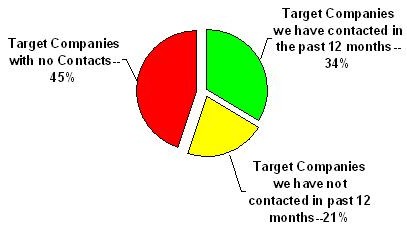
Analyze your Target Market CoverageRun your contact database against the list you have created. What percentage of the target market is currently there? How many more do you need to reach? Do the Same for Individuals. Do you have the type of contacts your sales people are looking for?


Establish Metrics
The end result of this analysis should be a measurement of coverage: “we have contacts at X% of the companies we are after, and Y% of them are at positions of interest to us.”

From this point on, marketing has two goals:
  1. Move the dial on these numbers to increase target market coverage.
  2. Generate repeat responses from target individuals at the target companies to create multiple opportunities for sales dialogue.
This is not a one-time analysis. These are numbers that you need to always have on your dashboard. Many executives are now adding demand generation metrics to their dashboards, so having agreed upon metrics is critical to establishing a common language for the boardroom conversation.
Stage Two: Figure Out HOW to Reach Them

Now that you know who you’re after, you need to figure out how to contact them and how to get them to respond to your message.

Get Additional Contact InformationThere is no easy or cheap way to add new target contacts to your list. However, if you have to spend the money, at least you’re better off now that you know exactly what you’re looking for. You can buy lists of names that will match the specific companies and titles you are after. One way or another, you’ll need to put someone on the phone to use your existing contacts within an organization to get these additional contacts you need to reach.

Look at Past ResultsGo back to your database and see what the people that fit your target profile responded to. What marketing vehicles seem to generate better response from your target prospects? Do certain messages seem to resonate better for specific segments?

Ask Them What They Care About
At times, we get so engrossed in analyzing our campaign data that we forget there is another way to find out how to get across to the people we are trying to reach: just ask them. Put together a short survey; ask them what their burning issues are and how they prefer to learn more about them. Have someone outside the company call them up; you’d be surprised how many people will give you a piece of their mind if you ask for it in a non-sales situation.


Stage Three: Execute and Measure

Get Started!With all this information in hand, you are ready to start creating the content, messages, and campaigns that are targeted at your desired audience. I know I make it sound simpler than it is. You can have a good starting point, but don’t expect to have all the answers upfront. You cannot wait for that. Just start executing to the best of your knowledge, then continue to test what works best and experiment with different ways to reach your target audience.

Measure Against Your GoalsAs you start generating leads, make sure you measure against the goals you have defined upfront:
  1. Target market response: how many TARGET MARKET responses have been generated?
  2. Target market coverage: how many NEW TARGET MARKET leads have responded?
As long as you keep hitting these goals, you are generating opportunities for your sales force to start a dialogue with the people they want to talk to and helping them move forward the dialogues that are already in place. And as long as you keep doing this, chances are your next board meeting is going to unfold better.

Some Additional Practical Details
As leads come in, you will need to figure out whether they fit your target market profile. The following chart describes a process you can use for that purpose.


Expecting sales to be responsible for the process is risky. I strongly recommend that you make this process part of marketing’s role in generating leads BEFORE they are passed to sales.


So put your gear in reverse, and get your engine going!

Share this post